



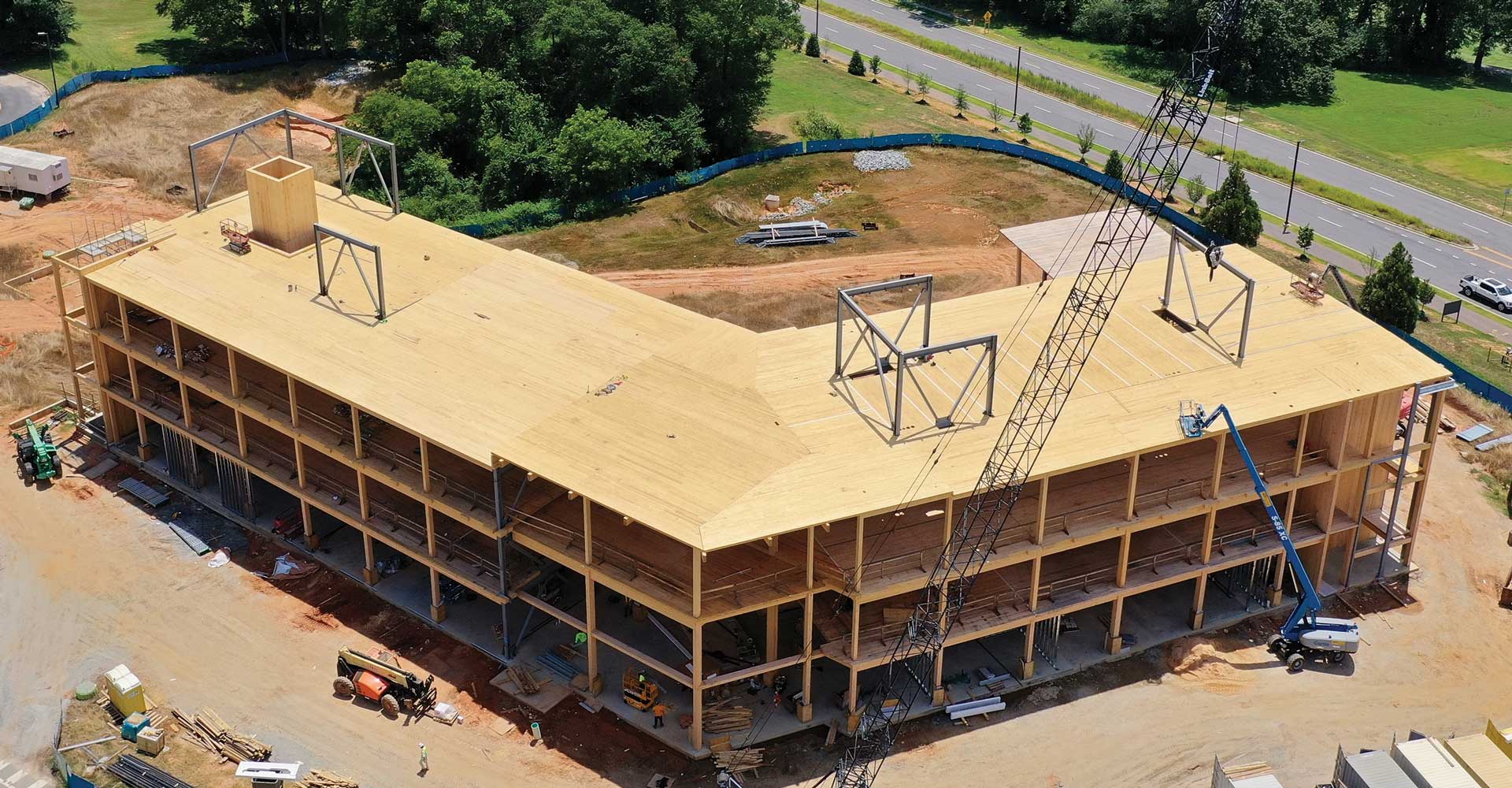
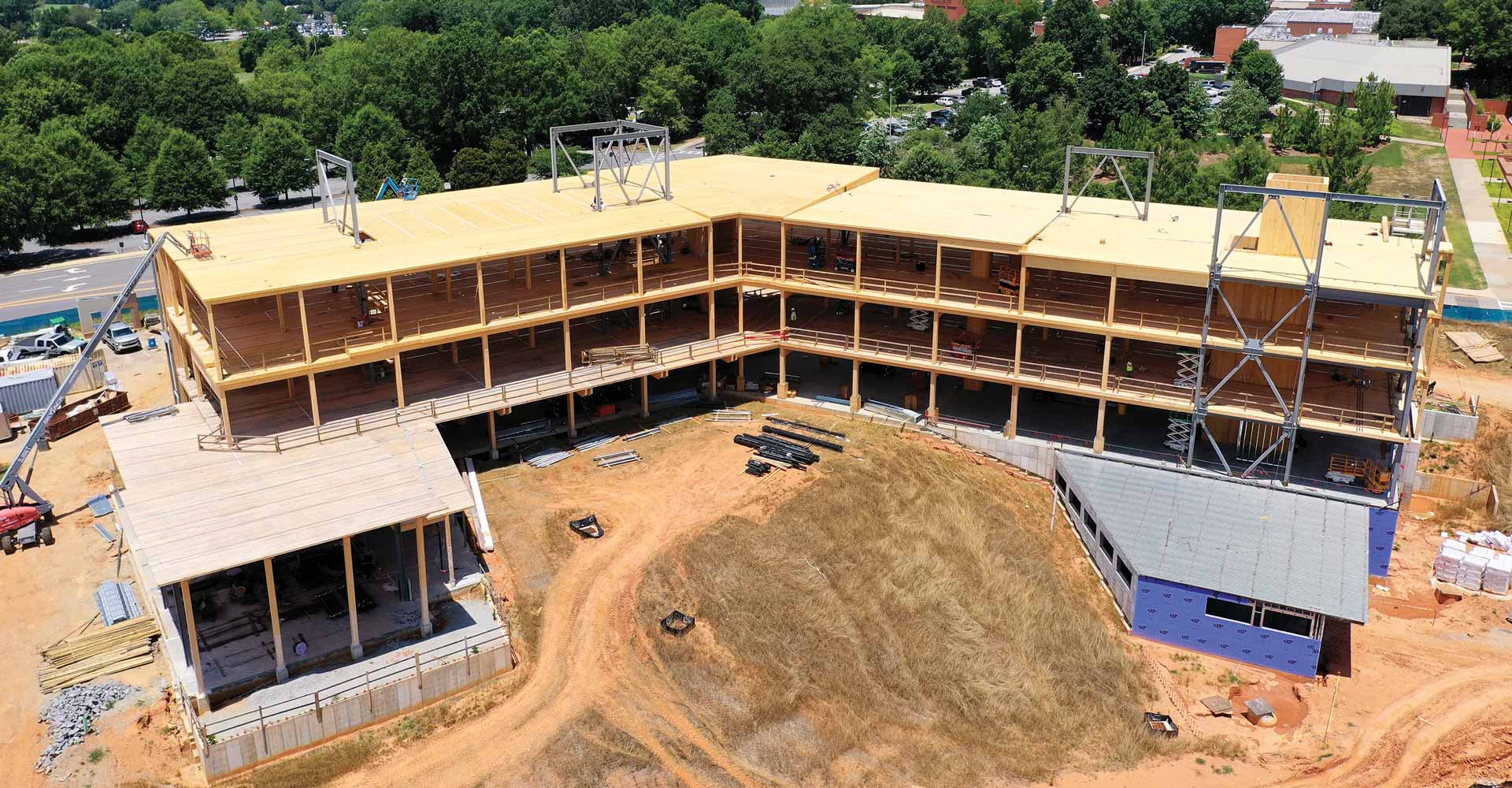
From sustainability and education to cutting-edge construction techniques, Clemson University’s Forestry and Environmental Conservation Building project has it all. The new 78,152sf mass timber structure is designed to house the university’s Forestry and Environmental Conservation (FEC) department, which is part of the College of Agriculture Forestry and Life Sciences (CAFLS). Together with Ajax Building Company and Moseley Architects, the university aims to welcome faculty and students in April 2026.
MASS TIMBER SHOWCASE
The Forestry and Environmental Conservation Building is one of the region’s premier examples of mass timber construction, using locally sourced southern yellow pine (SYP). “This approach hits on sustainability, schedule, and cost,” explains Tony Johnson, senior project manager at Ajax Building Company. He describes mass timber as a material that combines architectural beauty and structural integrity, saying, “From the moment you step inside, you feel a connection to nature, which is fitting for a building focused on forestry and conservation.” The mass timber components, fabricated in nearby Alabama, are carefully designed to minimize waste and reduce environmental impact—a process that aligns with Clemson’s commitment to sustainability.
But for Clemson University, the decision to use mass timber wasn’t only about sustainability—it was also an educational opportunity. With features like exposed cross-laminated timber (CLT) plank floors and glulam beams, the new facility will serve as living classrooms where FEC students can observe mass timber components up close. “This is a building designed to teach,” says Sam Verzella, another senior project manager at Ajax.
As the university explains, the facility will serve as a central hub for teaching, research, and outreach in wildlife, forestry, and natural resources management and conservation—all the while showcasing the adaptability and aesthetic qualities of wood construction through its use of mass timber and other engineered wood systems.

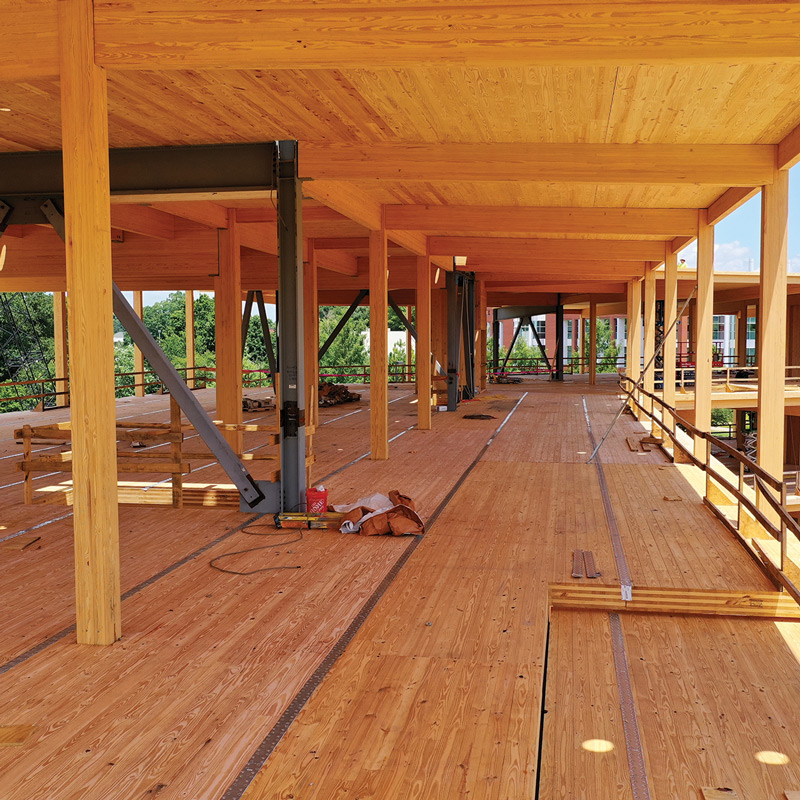
In fact, wood used in the building’s CLT components was harvested from Norfolk Southern’s Brosnan Forest, and timber sourced from the Clemson University campus will be featured in custom shelving and flooring. Led by the Wood Utilization + Design (WU+D) team, this effort highlights the building’s sustainability and environmental benefits, demonstrating the strong connection between mass timber construction, healthy forest management, climate resilience and carbon sequestration.

BUILDING TOGETHER
Building with mass timber comes with unique challenges. From coordinating the exposed mechanical, electrical, and plumbing systems to minimizing on-site adjustments, every detail requires precise planning. “You can’t have a chainsaw buzzing on a mass timber site—everything must be planned and fabricated in advance,” Verzella says.
This project has been a learning experience for everyone involved, and it’s taken a lot of collaboration with Clemson and the mass timber experts at STO Building Group to get it right.” ADDS TONY JOHNSON.
A GREEN IMPACT
The Forestry and Environmental Conservation Building is designed to meet the Green Globes certification standards—a building rating system that evaluates the environmental sustainability, health and wellness, and resilience of commercial buildings. Ajax is working closely with Clemson’s sustainability advocates and the design team to ensure the building meets these goals. By utilizing renewable materials like wood and incorporating energy-efficient systems, the project will be a top-tier example of environmentally conscious construction.
THE CLEMSON FAMILY
For much of the team, this project serves as a testament to the Clemson family. From project managers and superintendents to assistant PMs, Clemson graduates have been integral to the project’s success. Johnson, a Clemson civil engineering alumnus himself, adds, “There’s something special about being able to give back to your alma mater and work with others who share that connection.”
Verzella, whose daughters are both Clemson graduates, agrees. “The Clemson family isn’t just lip service, and it shows in how the alumni on our team, within our subcontractors’ teams, and within the university community work together.”
As the project progresses, the building stands as a beacon of innovation and collaboration, blending sustainability, education, and cutting-edge design. It is poised to become a source of inspiration for generations to come.