





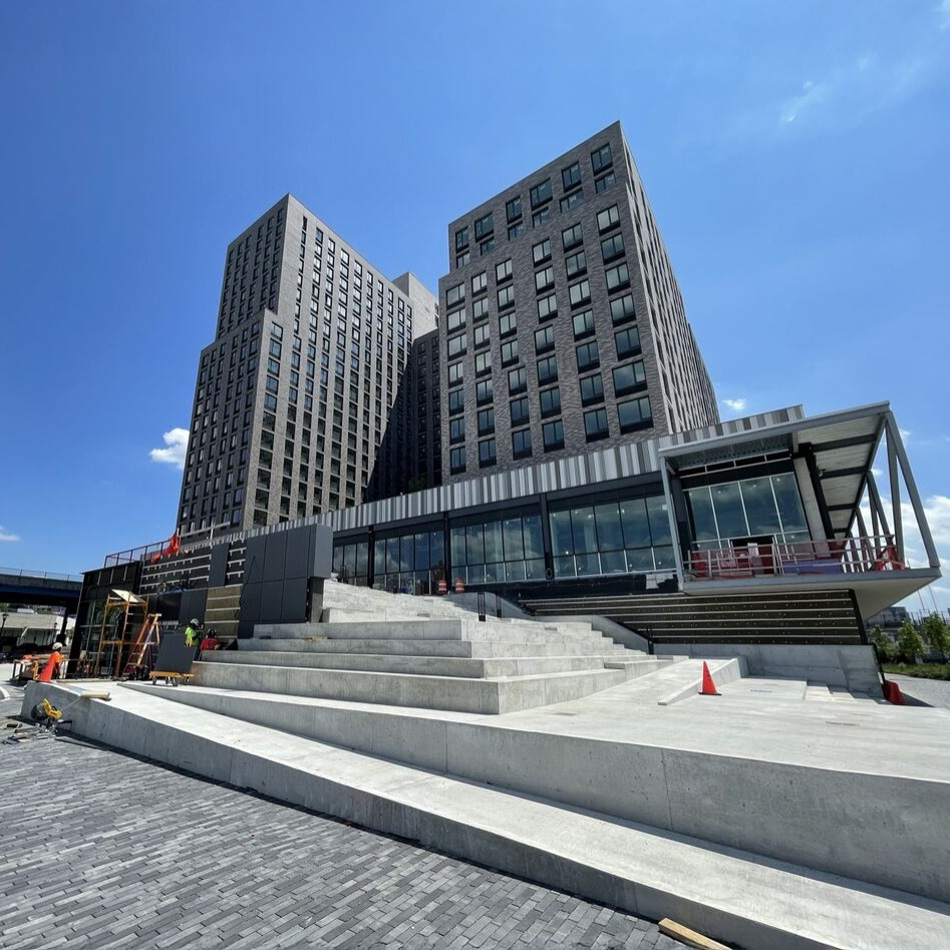
In the Bronx—where hip-hop was born—a new landmark is rising. The Hip Hop Museum will stand as a living monument to rhythm, resilience, and community. And for Pavarini McGovern, this building is more than a project; it’s a movement.
A PROJECT FUELED BY HEART
Pavarini McGovern has been guiding the museum’s construction since the project’s earliest presentations to the founder, working with passion,
precision, and pride to bring a global cultural legacy home to the New York borough. That same intentionality also shaped the team itself, with Pavarini McGovern partnering with the Velez Organization to support the museum’s mission.
For Joseph Renna, project superintendent at Pavarini McGovern and a native New Yorker, the Hip Hop Museum represents significant personal importance. Similarly, project manager Dinnel Roberts describes the project as completely from the heart. “You can see the excitement as each space takes shape,” says Roberts. “That energy drives everyone to create something grand.”
Preconstruction manager Yacine Ansari, who grew up in France, found inspiration in American culture and honed his English literacy through the poetic storytelling of Nas. This adds another layer to the team’s sharedpassion. “Hip hop is universal,” says Ansari. “It’s incredible to think that a movement born here in the Bronx now connects people around the world.” For all three team members, helping build a museum dedicated to the music that shaped their youth feels like coming full circle.

BUILDING WITH RHYTHM
Translating that passion into a physical space hasn’t been without challenges. The museum—encompassing more than 55,000sf of galleries, theaters, and interactive installations required both technical innovation and logistical finesse.
“The space was brand new, which gave us creative freedom,” Renna explains. “But it also meant we were starting completely from scratch.” Managing deliveries and coordinating large equipment in a tight urban environment proved to be one of the project’s biggest hurdles.
The museum’s theater also posed one of the most intricate construction challenges. Designed for complete acoustic isolation, it required “a room within a room” structure—walls and floors built independently from the main frame and connected through specialized dampers to block sound transmission. Achieving that level of isolation meant coordinating with multiple trades down to the millimeter. Electrical conduits, lighting supports, and HVAC ducts all had to be reimagined to avoid creating sound bridges between structures. The team even chose specific screws and clips for their vibration control.
TECHNOLOGY MEETS CREATIVITY
As the museum took shape, the Pavarini McGovern project team blended innovation with craftsmanship. “We use MyComply with SST cards to track safety certifications and who’s on-site each day,” Renna says. “We also set up multiple camera systems—one for security and another for time-lapse documentation—to capture the evolution of the project.”
But as Roberts points out, technology alone doesn’t drive success—it’s teamwork that keeps the beat steady. “The digital tools keep us organized,” she says, “but the collaboration keeps us inspired. Everyone here knows what this project represents, and that shared purpose fuels everything we do.”
A SHARED SENSE OF PRIDE
That shared purpose has shaped every step of construction. For Renna, who spent years managing projects across the country, the Hip Hop Museum feels unlike anything he’s ever built.
Some projects are built to be seen, but this one is built to be remembered,” SAYS JOSEPH RENNA.
As construction nears completion, the team looks forward to opening day with anticipation and pride. Roberts notes that she’s most excited for visitors to feel the history and love that’s been built into every corner, and Ansari looks forward to sharing the moment with his young son, knowing that the museum’s message of creativity and unity will inspire the next generation. In the end, the Hip Hop Museum is more than a construction project—it’s a cultural legacy built on rhythm, resilience, and respect.
As Roberts puts it, “We’re not just building a museum. We’re helping build the story of hip hop itself.”