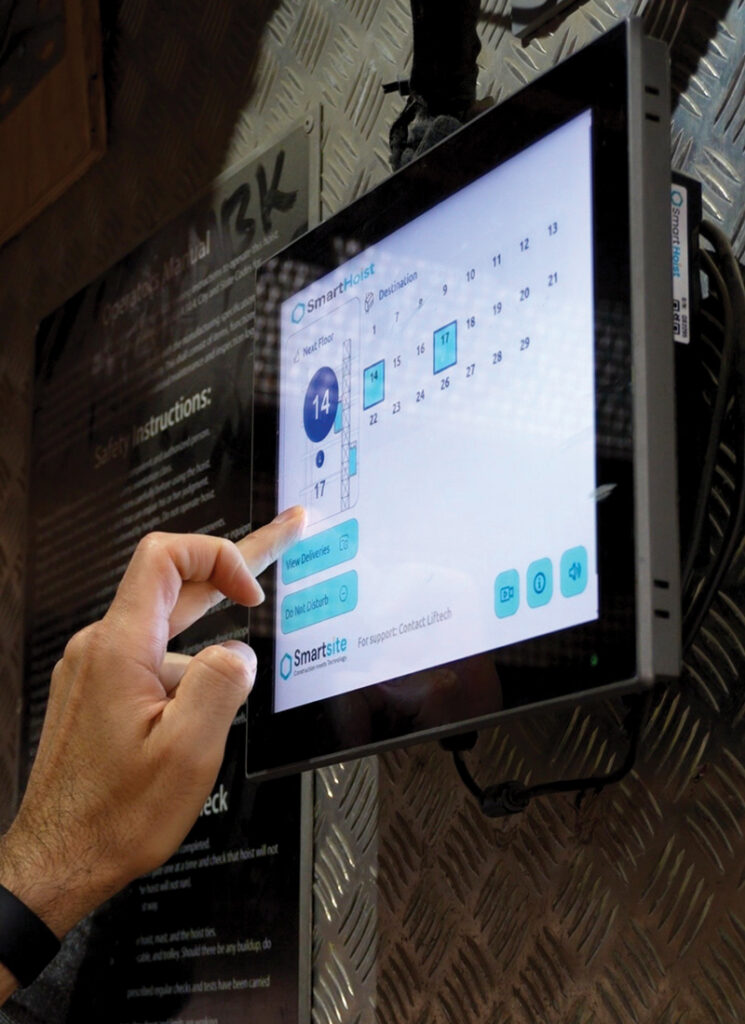
Responding to the challenges of vertical transport in large high-rise projects, Pavarini McGovern teams are making use of SmartHoist and Smart Lift—AI-driven solutions that reduce delays and improve efficiency.
Hoists and lifts, temporary vertical transport systems used during construction, have been an essential part of modern high-rise building for decades. However, as schedules compress and deadlines loom, project teams can become stranded in lengthy queues disrupting work in the process.
Enter Smartsite’s SmartHoist and Smart Lift, technology solutions that leverage artificial intelligence (AI) to streamline site operations. Several Pavarini McGovern (PMG) teams have been making use of these solutions, reporting positively on its efficiency and ease of use.
A CRITICAL CHOKEPOINT
Historically, lifts and hoists have been drivers of jobsite efficiency. But as trades stack and schedules compress, they can also become critical pinch points.
According to Michael McFadden, Superintendent for PMG, vertical transportation can be especially challenging on taller building projects.
“Traditionally, you’d have an operator, running either a hoist or an inside car, and stopping on floors to call out and see if anyone’s there,” McFadden says. “If you have a shorter building, that may work. But with taller buildings here in Manhattan, it can lead to lengthy delays.”
Edwin Verpoort, CEO of Smartsite, echoes the concern, noting that vertical transport can be a key source of lost productivity.
We’ve seen that the hoist is essentially the vertical highway on a construction site,” EDWIN VERPOORT SAYS. “On an average jobsite, multiple hoists may be serving 400–500 workers. We’ve seen that the average worker can spend around half an hour per day waiting for vertical transportation. That’s why we say: wait time is not work time.”
His company developed SmartHoist, a plug-and-play construction hoist management platform, followed by Smart Lift, which brings the technology into interior lift systems. These tools use AI to understand and route vertical transportation systems. By connecting call buttons, displays, sensors, and data dashboards into a single solution, they aim to reduce delays and improve visibility.
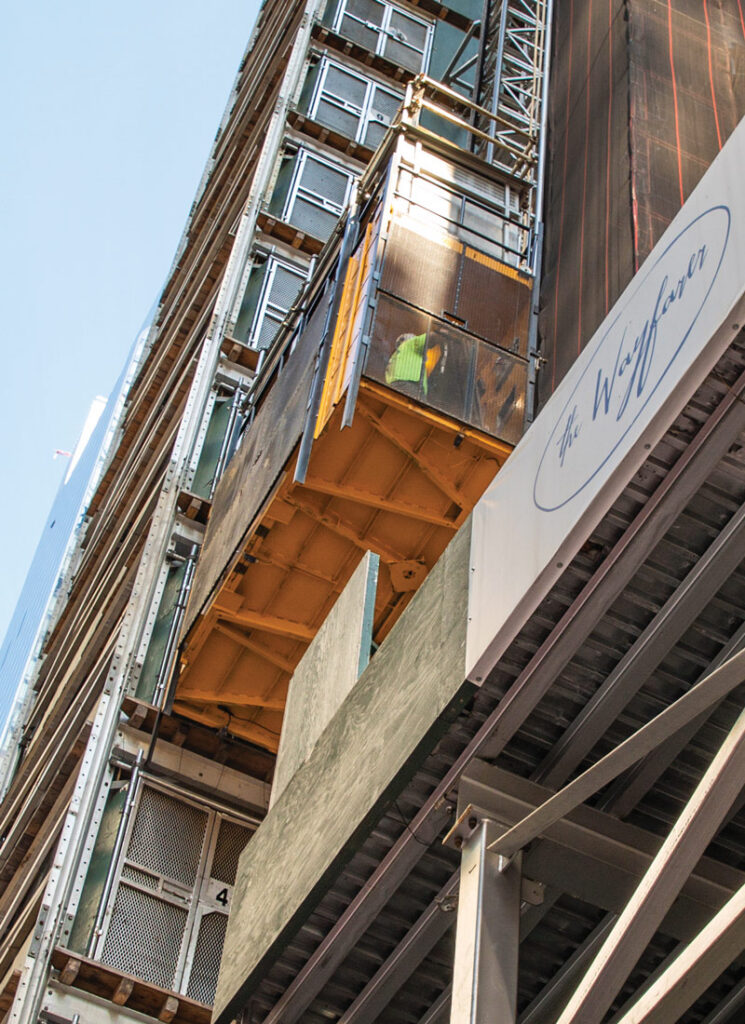
Verpoort stresses the need to learn from real work patterns on the project rather than follow a one-size-fits-all model. “We compare the planned schedule—how the client expects crews and materials to move—with the actual real-time data,” he explains.
“This allows us to track differences and give that information directly to the client.”
McFadden has found success with the tool, which he’s currently using on a New York City jobsite. “On my project, we have three elevators running for construction,” he says. “All three of our interior cars have a screen where, when someone is on a floor, they hit up or down, and it’ll alert the operator. It really streamlines the process so that they’re not stopping on every floor.”
FIELD ADOPTION
New technology can sometimes require extensive training. But according to Christopher Pesch, Senior Superintendent for PMG, adoption on his New York jobsite has been straightforward.
“It’s very user-friendly. Our hoist and elevator operators picked it up quickly,” Pesch says. “They know how to disable calls for large deliveries and manage the system without much training.”
Pesch appreciates several key features.
“It includes tracking features, reliable service support, and overall better functionality,” he adds. “We can track how long the elevators are running, how many stops are made on each floor, and monitor usage in several different ways.”
Improving vertical transportation is less about introducing technology for technology’s sake and more about adapting to the realities of modern construction. That includes listening to field teams about the challenges they face and the realities of their work.
“We want to understand what is important to our clients,” Verpoort says. Smartsite has also developed SmartWorker, a workforce-tracking solution, and the Smartsite Booking Platform, which helps with coordinating and booking assets such as cranes, hoists, forklifts, and loading bays.
As high-rise buildings continue to grow in scale and complexity, technology is driving a broader shift in the construction industry. Rather than replace experienced field professionals, new tools can help project teams achieve greater awareness and efficiency.