

By Brooks McDaniel, Senior Vice President, STO Building Group
We’ve all seen the headlines about the office-to-residential conversion boom. From New York to San Francisco, policymakers and developers have embraced the narrative that underutilized office buildings could be the key to solving both housing shortages and commercial real estate distress.
But as more projects make their way from concept to construction, a new trend is emerging: office-to-hybrid (or mixed-use) conversions. This approach involves retaining some office space, layering in residential, and integrating ground-floor retail or amenity space. Depending on the original asset, these types of transformations can be more feasible and more valuable than a full office-to-residential conversion.
So, what’s driving this shift, and what should owners and developers be thinking about when considering their next repositioning strategy?
Full Conversions: More Complicated Than They Seem
From a distance, the logic of converting empty office towers into apartments seems straightforward. In practice, the structural, zoning, and financial hurdles can be challenging, and the existing tenants may have long leases that can be difficult and expensive to terminate early.
Class B and C office buildings simply weren’t designed for residential use. Deep floor plates, limited window access, and core locations that work well for desks but not for kitchens and bathrooms can quickly add cost and complexity. Add to that life safety requirements, MEP upgrades, and the need for light and air compliance, and it becomes clear why some full conversions become financially unrealistic. While these challenges can be overcome in certain buildings, some developers and building owners may find that hybrid conversions offer a promising middle ground.

The Hybrid Model: Flexible, Phased, and Financially Viable
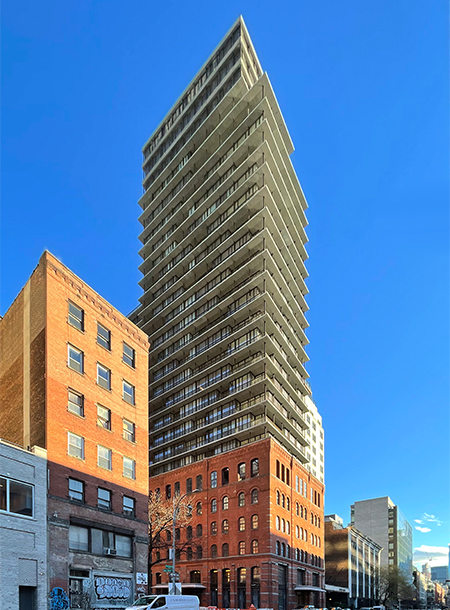
Hybrid conversions might include transforming the upper floors of a building into residential units while keeping the lower levels for office, coworking, or retail. Some even include hotel or hospitality components. Others reconfigure space for community facilities, medical offices, or educational facilities. From a construction standpoint, this flexibility allows us to phase the work for each end-user, minimize disruption, and tailor infrastructure upgrades to the needs of each occupant type. It also opens the door to diversified revenue streams, broader leasing potential, and resilience in changing market cycles. Lastly, it allows the option to retain existing commercial and retail tenants who would otherwise have to vacate the building for a full conversion.
At STO Building Group, we’re seeing more clients explore these options, particularly in urban areas where the live-work-play model is in high demand. In New York City alone, Pavarini McGovern has embarked on several new office-to-hybrid projects. The team is currently in the preconstruction phases of reconfiguring 342,000sf at 845 3rd Avenue, 235,000sf at 300 East 42nd Street, and 515,000sf at 100 Wall Street.
What to Look for in a Hybrid Conversion Prospect
Not every building is a fit for this strategy, but here are some characteristics we look for when evaluating hybrid potential:
- Zoning Flexibility: Buildings in areas with mixed-use codes have more options from the start.
- Column Spacing and Floor Depths: Shallow floor plates and generous window lines improve feasibility for residential use.
- Multiple Cores and Entry Points: Separate access for different user groups (office tenants and residents, for example) helps streamline operations. An existing large lobby is easier to subdivide into two or more smaller lobbies for individual uses.
- Mechanical and Utility Capacity: The ability to zone systems separately or upgrade incrementally is key.
- Location: Buildings located near transit, amenities, and neighborhoods with unmet housing needs are well-positioned.
Making the Case for Value
While hybrid conversions may not deliver the scale of residential units that a full conversion might, they can deliver greater certainty and a faster speed to market. Mixed-use configurations allow owners to respond dynamically to demand—leasing up commercial space during strong office cycles or shifting toward more residential or hospitality as the market changes. In today’s world of high interest rates and risk aversion, that kind of adaptability is a definite advantage.
In our post-pandemic reality, it’s clear that no one-size-fits-all solution exists. Office-to-residential conversions are still a powerful tool in the urban development playbook, and hybrid repositioning is another smart, scalable way to unlock value.
About Brooks McDaniel
Brooks leads STO Building Group’s Building Repositioning practice, guiding strategy and execution across the organization with a focus on complex transformations in the New York City market. His experience spans design, development, and construction, shaped by prior roles at Extell Development Company and SHoP Architects. A registered architect, Brooks brings a multidisciplinary perspective to repositioning projects, leveraging his background in both architecture and real estate to help clients unlock long-term value from underutilized assets.