Smarter Schools from the Ground Up: How Mass Timber Builds Better Learning Environments
By Pete Kobelt, Director of Mass Timber, STO Building Group
Author’s Note: This article references findings from the Mass Timber Schools Report (2021), published by the Mithun Research & Development Initiative. We gratefully acknowledge the contributions of Craig Curtis, Partner & Director of Emerging Building Technologies at Mithun , and the research team whose work has helped inform industry best practices for mass timber in educational facilities.
As builders, we’re delivering spaces where families, students, colleagues, and communities gather. Nowhere is that more evident than in our school projects. While the metrics of budget and schedule remain critical, forward-thinking districts are expanding the definition of project success: improved student outcomes, reduced environmental impact, and buildings that contribute to long-term community health and quite simple, beautiful to behold.
Enter mass timber: a material that’s part of a larger system with the power to transform how we build schools. Thanks to data from Mithun’s comprehensive Mass Timber Schools: Building for Wellness report, we now have a detailed playbook for how mass timber construction delivers results for students, teachers, and communities.
The Case for Mass Timber in K-12 Construction
Traditional school construction often defaults to concrete and steel—a familiar pairing of durability and code compliance. But the Mithun report challenges that status quo, offering compelling evidence that mass timber is a viable, competitive, healthy, and holistic alternative.
So, what’s driving the shift?
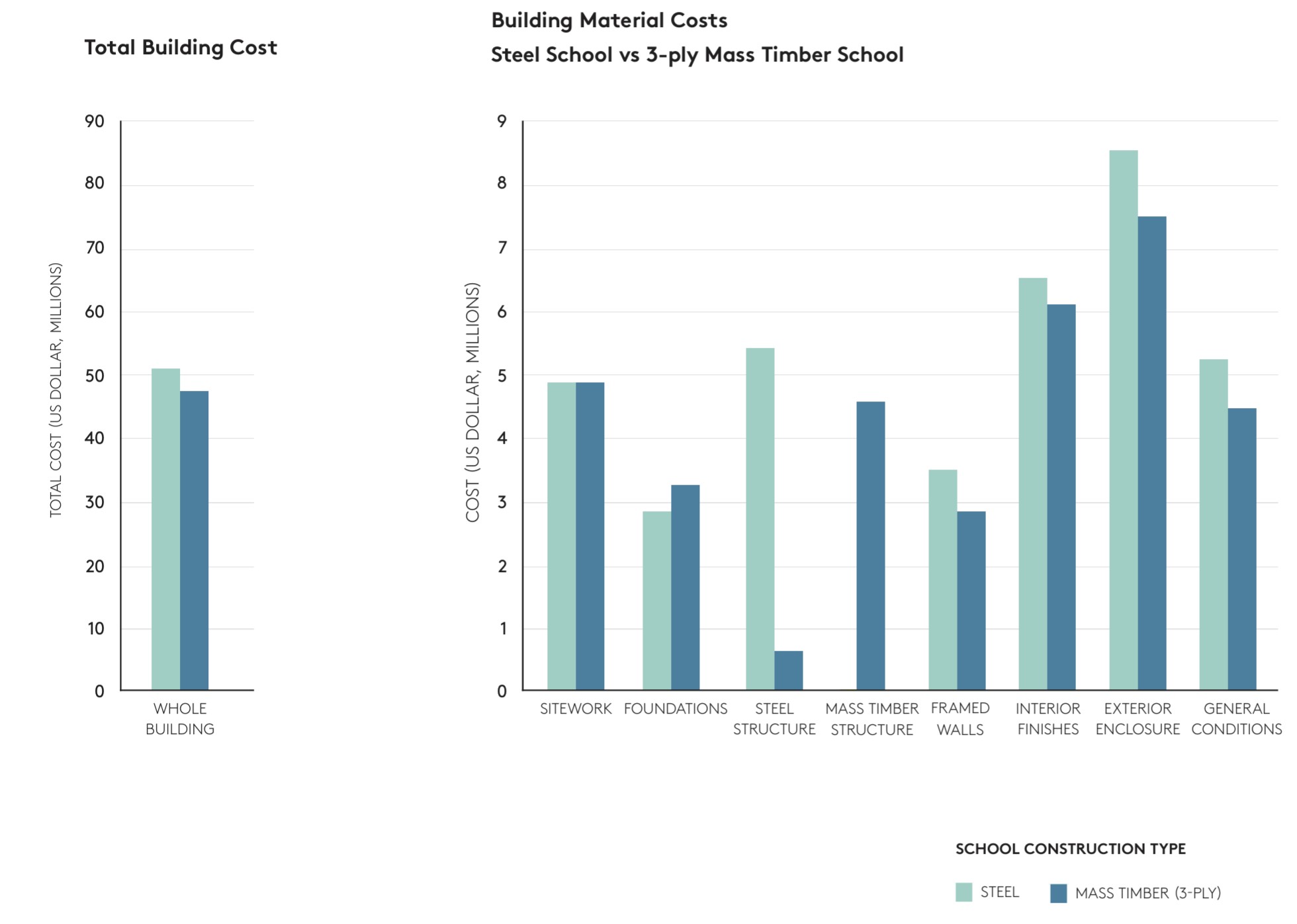
Cost Competitiveness: In many cases, whole-building costs for mass timber designs are on par with concrete and steel, especially when factoring in speed of construction and reduced site impacts.
Schedule Efficiency: Prefabrication and just-in-time delivery reduce site construction time by up to 25%, easing disruptions to adjacent school operations and surrounding neighborhoods.
Environmental Stewardship: Mass timber buildings demonstrate a 102% reduction in embodied carbon compared to steel-frame baselines. This is largely due to the carbon sequestering properties of wood and the lower emissions during production.
Biophilic Design and Student Wellbeing
What truly sets mass timber apart isn’t just what it’s made from, but what it makes possible.
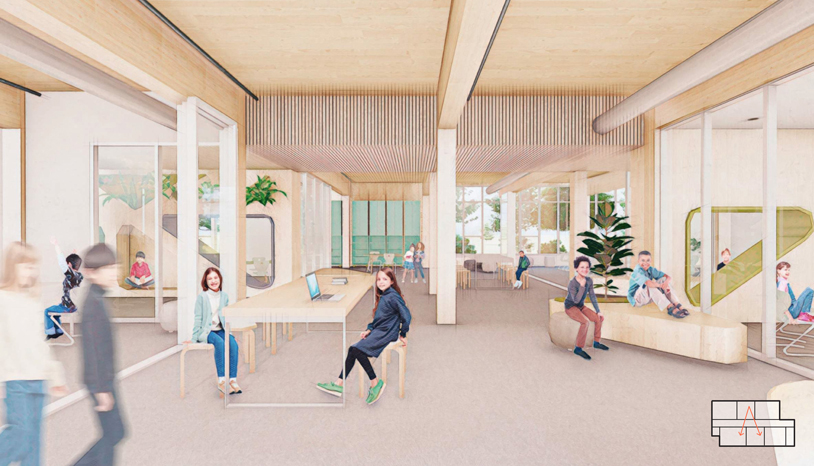
A growing field of research shows that natural materials can reduce stress, lower blood pressure, and boost cognitive function. At Green Street Academy, a case study included in the report, students in a biophilic classroom showed 3.3 times the academic improvement in math scores compared to those in traditional classrooms.
Teachers noted a calmer classroom environment, and HRV (Heart Rate Variability) measurements (a biomarker of stress) confirmed lower stress levels in mass timber classrooms. This data makes it clear that building with mass timber can be so much more than a material choice. It has the power to create schools that support students physically, emotionally, and intellectually.
A System for Flexibility and Teaching Innovation
Some school districts may wonder, “Can mass timber keep up with evolving curriculum models?” According to the report, the answer is a resounding yes.
Mithun introduces a mass timber “kit-of-parts” framework—modular, prefabricated design strategies that offer both cost efficiency and spatial flexibility. These systems are tailored to core learning, performance blocks, and shared learning environments, and are adaptable for:
Source credit: Mithun Research & Development Initiative, Mass Timber Schools Report (2022)
Source credit: Mithun Research & Development Initiative, Mass Timber Schools Report (2022)
Ground-up construction
Portable classroom replacements
Permanent expansions
Schools can evolve with teaching methods, from traditional double-loaded corridors to open, collaborative hubs. As teaching methodologies continue to shift toward project-based and cross-disciplinary learning, the mass timber kit-of-parts enables environments to shift right alongside them.
Mass Timber Meets the Moment
As climate goals intensify and districts look to future-proof their facilities, mass timber offers a resilient, repeatable, and regionally manufacturable approach to construction. With a 1,000% increase in North American manufacturing capacity for mass timber products over the past decade, supply chains are maturing, and code acceptance is expanding nationwide. With proven performance in seismic, fire, and durability testing, it’s clear: mass timber is ready for prime time.
Source credit: Mithun Research & Development Initiative, Mass Timber Schools Report (2022)
Pete has been engrained in the exploration of mass timber in the US since its early days, contributing to the conception and establishment of the first CLT manufacturing plants in the US and the first and largest mass timber student housing project in the US. His passion stems from his time spent studying the dramatic advances in engineered wood manufacturing and construction in Switzerland, Austria, and Germany.